| TL;DR
• Content isn’t decoration around marketing. It’s the mechanism that builds belief (trust) and relatability (resonance), the two things every buying decision runs on, whether the buyer is a plant manager or a first-time skincare customer. • Six sectors, manufacturing, engineering, wellness, financial services, technology and healthcare, each face a distinct acquisition challenge. In every case, the real blocker is a trust or resonance gap, not a demand gap. • Winning brands run an integrated content model: articles, video, social, UGC, paid and influencer content, deliberately placed on LinkedIn, Meta, Pinterest and other platforms based on where the buyer actually spends time. • As ChatGPT, Gemini, Perplexity and Claude increasingly do a buyer’s first round of research, well-structured and credible content is what gets cited. This is generative engine optimisation (GEO), and it is built on the same foundation as brand trust. • For technical or sensitive categories like healthcare and engineering, a hybrid model, AI-assisted drafting with rigorous human and expert review, consistently outperforms either fully manual or fully automated content. |
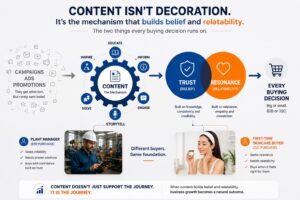
Every brand says it wants more leads, more customers, more visibility. Almost none of them say what they actually need first, which is to be believed and to feel familiar. Content marketing gets discussed as a channel, a budget line, a set of deliverables. That framing undersells what it actually does. Content is the mechanism through which a brand earns belief and builds relatability, and those two things are the actual currency behind every business relationship, whether it is a manufacturing plant signing a multi-year supply contract or a first-time customer choosing a wellness brand off an Instagram reel.
This article makes the case that content marketing sits at the core of brand communication precisely because it is the most scalable way to build trust and resonance at the same time. It looks at where that trust breaks down across six sectors, how an integrated content model closes the gap, why the rise of AI-driven search makes credible content more important rather than less, and where AI-generated content should stop and human judgement should take over.

Trust and Resonance
Brand trust and brand resonance often get used interchangeably in marketing decks, but they are doing different jobs. Trust is belief. It answers the question a buyer asks silently before any transaction: can I rely on what this brand tells me? Resonance is relatability. It answers a quieter, more emotional question: does this brand understand a situation like mine?
A B2B buyer evaluating an engineering partner is not choosing based on a tagline. They are looking for proof that the vendor has solved a problem like theirs before, and for a tone and a body of work that feels like it was written by people who actually understand the specification sheet, not a marketing team translating it after the fact. A D2C customer scrolling past a wellness ad is running the same two checks in a more compressed form: does this look credible, and does this sound like someone talking to me rather than at me?
Content marketing is the only marketing discipline that can build both at once, because content is where a brand demonstrates expertise (which produces belief) and where it chooses language, examples and tone (which produces relatability). Advertising can buy attention. Only content can build the belief and familiarity that turn attention into a relationship.
Where Trust Breaks Down: A Sector-by-Sector View
Client acquisition in B2B and customer acquisition in D2C are usually diagnosed as a demand problem or a pricing problem. More often, they are a trust and resonance problem wearing a different label. The table below sets out how this plays out across six sectors.
| Sector | Typical Acquisition Challenge | How Trust & Resonance Show Up |
| Manufacturing (B2B) | Long sales cycles, risk-averse buyers, low brand visibility beyond RFQs | Technical credibility, plant-level proof, case studies that read like engineering documentation, not marketing copy |
| Engineering (B2B) | Highly specified, project-based buying; reputation travels by word of mouth | Demonstrated domain depth, past project transparency, thought leadership from qualified voices |
| Wellness (D2C/B2C) | Crowded category, skepticism toward claims, short attention spans | Relatable founder or practitioner stories, visible community proof, honest ingredient or method transparency |
| Financial Services (B2B & D2C) | Trust deficit built into the category itself; regulatory caution | Plain-language explainers, transparent disclosures, credentialed authorship, consistent tone across touchpoints |
| Technology (B2B) | Feature parity across competitors; buyers can’t easily tell products apart | Outcome-led narratives, integration proof, customer voice over vendor claims |
| Healthcare (B2B, D2C & B2C) | High stakes, low tolerance for error, and a well-informed but anxious audience | Clinically reviewed content, credentialed contributors, empathetic framing without overpromising |
Table 1: Client and customer acquisition challenges by sector, and the trust/resonance lever that addresses them
Look closely and a pattern shows up across every row. The sector, the buyer type and the price point change, but the underlying blocker does not. It is either a belief gap (the buyer isn’t convinced the brand can deliver) or a relatability gap (the buyer doesn’t feel understood), and often both at once. Content marketing, done with intent, is the most direct lever available to close either gap.

The Integrated Content Marketing Model
Once the trust and resonance gaps are identified, the next question is practical: which content, on which platform, for which purpose? Brands that get this right don’t treat formats and platforms as interchangeable. They build one coherent brand narrative and then deliberately route different pieces of it through the channel best suited to that job.
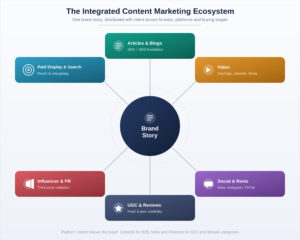
Figure 1: One brand story, distributed with intent across formats and platforms
| Format | Best-Fit Platform(s) | Primary Role | Segment Fit |
| Long-form articles & blogs | Owned website, LinkedIn Articles, Medium | SEO and GEO foundation; depth and citation-worthiness | B2B & D2C |
| Video (explainer, testimonial, demo) | YouTube, LinkedIn, Instagram | Builds relatability at scale; strong for complex ideas | B2B & D2C |
| Short-form social & reels | Meta (Instagram/Facebook), TikTok | Reach, discovery, cultural relevance | D2C, wellness, lifestyle |
| Professional posts & carousels | Positions expertise; drives B2B consideration | B2B, engineering, tech, fintech | |
| User-generated content & reviews | Instagram, Google, G2, Trustpilot | Peer proof; the strongest resonance lever | B2B & D2C |
| Paid display & search ads | Google Ads, LinkedIn Ads, Meta Ads | Awareness and retargeting on top of existing content | B2B & D2C |
| Influencer & creator partnerships | Instagram, YouTube, Pinterest | Borrowed trust; effective for wellness and D2C | D2C, wellness |
| Visual & lifestyle content | Discovery and inspiration for wellness and home/lifestyle | D2C, wellness |
Table 2: Content formats mapped to platform, purpose and segment fit

Two working principles hold across almost every account we have studied. First, LinkedIn remains the anchor platform for B2B narratives, engineering, manufacturing, technology and B2B financial services, because it rewards depth and professional credibility over spectacle. Second, Meta and Pinterest dominate D2C and lifestyle categories such as wellness, because discovery and emotional resonance matter more than technical proof at the top of the funnel. Brands that try to force one platform’s content style onto the other usually end up with content that performs adequately everywhere and exceptionally nowhere.
| CASE STUDY SPOTLIGHT
This is exactly the model we run for our own B2B clients at Ace Logic Solutions, content marketing, brand communication and PR managed as one integrated engine rather than three separate disciplines, because a fragmented approach is what produces the trust and resonance gaps this article has walked through. We’ve documented this across 12 client case studies spanning multiple sectors including manufacturing, engineering, technology and financial services. Explore the integrated approach and case studies here. |
User-generated content and third-party reviews deserve a special mention. Across every sector examined here, peer proof consistently outperformed brand-authored claims on the resonance dimension. A customer’s own words, a client’s own case study quote, a practitioner’s own before-and-after post, do more to build relatability than any brand copywriting can, precisely because they are not brand copywriting.
The New Search Reality: SEO, GEO and the Agentic AI Layer
For two decades, content marketing’s organic value was measured almost entirely through search engine rankings. That is changing, and the change matters more than most brands currently realise. A growing share of research and evaluation, the work a buyer used to do by opening ten browser tabs, is now being done for them by AI systems. ChatGPT, Perplexity, Gemini and Claude are increasingly the first stop, not the search engine results page.
This shifts the objective. It is no longer enough to rank. Content now has to be structured, specific and credible enough that an AI system chooses to reference it when answering someone else’s question. That is the essence of generative engine optimisation, sometimes called GEO or answer engine optimisation. Practically, it rewards clear claims, well-labelled sections, direct answers to likely questions, and content that demonstrates real expertise rather than generic coverage of a topic.
The important point for brand strategy is that GEO does not run on a separate foundation from brand trust. It runs on the same one. AI systems are more likely to cite content that reads as authoritative, specific and well-sourced, which is exactly the kind of content that also earns human trust. Brands chasing AI citation and brands chasing genuine credibility are, in practice, chasing the same outcome. This is good news: investing in real E-E-A-T, experience, expertise, authoritativeness and trustworthiness, pays off in both search and generative AI environments at once, rather than requiring two separate content strategies.
AI Content vs the Human Angle: Where the Line Should Sit
The volume of content that can now be produced with AI tools has gone up by an order of magnitude, and that shift is not going to reverse. But volume and credibility are not the same axis, and for certain categories they actively pull apart. Mass-produced AI content tends to converge toward the average of what already exists online, competent, generic, and largely indistinguishable from a hundred similar pieces. That is a real limitation for categories like healthcare and engineering, where the value of content lies precisely in specific, nuanced, hard-won expertise that an average of existing content cannot reproduce.
A useful way to think about this is a spectrum rather than a binary. At one end sits high-volume, low-stakes content, product descriptions, routine social posts, first-draft outlines, where AI-generated content is efficient and low risk. At the other end sits high-stakes, high-specificity content, clinical guidance, engineering specifications, regulated financial advice, where an unreviewed AI draft carries real reputational and even safety risk.
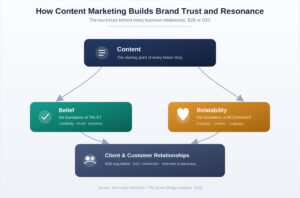
Figure 2: Content is the input; belief and relatability are the outputs that build every client and customer relationship
The sustainable answer for specialised sectors is a hybrid workflow: AI-assisted drafting for speed and structure, paired with rigorous review by a subject-matter expert and an editor who understands the audience. This is not a compromise position, it is becoming the professional standard. Brands in healthcare and engineering that skip the human review step to save time are the ones most likely to publish something technically wrong or tonally off, and in categories where trust is fragile to begin with, that is an expensive mistake to make in public. As AI content becomes more common and more visible, an authentic, well-reviewed human perspective is likely to become a differentiator in itself rather than just a quality-control step.
Actionable Insights: What to Do With This
- Audit your last ten pieces of content and ask which trust lever (belief) or resonance lever (relatability) each one was actually built to pull. If most of them are pulling neither, that is the gap to close first.
- Map your content formats against the platform table above and check for mismatches, technical B2B content posted mainly on lifestyle-first platforms, or D2C brands over-investing in LinkedIn.
- Prioritise structuring your existing best content for AI citation: clear headings, direct answers near the top, specific claims with context, before creating new volume.
- Build a lightweight review layer for any AI-assisted content in regulated or technical categories, a named expert reviewer and a documented sign-off step, rather than treating this as optional.
- Invest deliberately in UGC and third-party proof; it is consistently the highest-resonance content type across every sector examined here.
Conclusion
Content marketing earns its place at the centre of brand communication because it is the one discipline built to do two jobs at once: prove that a brand can be believed, and show that a brand understands the person or business on the other side of the transaction. That has not changed with the arrival of AI-driven search. If anything, the rise of agentic AI as a research layer raises the bar, because the content that earns AI citation and the content that earns human trust turn out to be the same content: specific, credible, well-structured and honestly reviewed. Brands that treat content as a strategic trust-building asset, not a volume game, are the ones positioned to win both the human buyer and the AI system standing in front of them.
Frequently Asked Questions
What is the difference between brand trust and brand resonance?
Brand trust is belief, the confidence that a brand will deliver what it claims. Brand resonance is relatability, the sense that a brand understands a buyer’s specific situation. Content marketing is one of the few disciplines that can build both at the same time.
Which sectors struggle most with brand trust in content marketing?
Manufacturing, engineering, financial services and healthcare tend to carry the highest trust barriers because of long sales cycles, regulation, or the stakes involved in the buying decision. Wellness and D2C categories face a related but distinct challenge: a crowded market and buyer skepticism toward unverified claims.
What is GEO (generative engine optimisation) and how is it different from SEO?
SEO optimises content to rank in traditional search engine results. GEO optimises content to be referenced or cited by AI systems such as ChatGPT, Gemini, Perplexity and Claude when they answer a user’s question directly. The two are complementary rather than competing disciplines, and both reward clear, credible, well-structured content.
Should healthcare and engineering brands use AI-generated content?
AI tools can speed up drafting and structuring, but content in high-stakes, technical categories should always go through review by a qualified subject-matter expert before publication. A hybrid workflow, AI-assisted drafting with human review, is the most sustainable approach for these sectors.
Which social platform works best for B2B versus D2C content?
LinkedIn is generally the strongest platform for B2B categories like manufacturing, engineering, technology and B2B financial services. Meta (Instagram and Facebook) and Pinterest tend to perform better for D2C and lifestyle categories such as wellness, where discovery and emotional resonance drive early-funnel engagement.
About This Article
This article is authored based on direct, hands-on experience across multiple sectors including industrial components, specialty chemicals, precision engineering, packaging, and capital equipment. The strategies, data benchmarks, and frameworks presented are drawn from real-world client engagements and observed commercial outcomes — not from theoretical models or secondary research aggregation.
This article does not represent or endorse any specific agency, platform, or vendor. The intent is to provide actionable, experience-backed perspective to decision-makers evaluating the commercial case for digital marketing investment.
Notes & Disclaimers
- This article is written for members of the business community and is not intended for academic use.
- For branding and digital marketing strategies in specialised sectors, please share your business context and objectives at: info@acelogicsolutions.com
About Ace Logic Solutions
Ace Logic Solutions is a Mumbai-based integrated digital marketing and brand solutions agency, working with B2B and D2C brands across manufacturing, engineering, professional services, fintech, wellness, and technology sectors since 2019. With 100+ clients across 24+ sectors, the agency specialises in strategy-led digital marketing that drives real business outcomes — not just metrics.
www.acelogicsolutions.com | Mumbai, India

Ace Logic Solutions is a business success partner specializing in integrated strategies across multiple sectors. We provide insights-driven solutions through our unique PLAY approach, helping businesses navigate challenges, optimize performance, and unlock new growth opportunities. Our articles offer actionable insights on brand strategy, digital marketing, and business consulting to drive lasting success.