
B2B companies typically deprioritise social media in favour of whitepapers, articles, and technical content. However, social media is a critical integrated component of B2B digital marketing for the following reasons:
• B2B buyers are humans who scroll social media — including Meta platforms, not just LinkedIn.
• Social content reaches decision-makers in a relaxed, open-minded state, improving content receptivity and CTR.
• Email marketing hits when users are in work mode with priorities — social is chosen, making it a softer, more effective entry.
• Social media for B2B is a downstream adaptation of existing B2B content — minimal incremental cost.
• Meta paid ads are significantly more cost-efficient than Google Performance Max for B2B lead generation.
• Omnipresence across platforms signals credibility and supports LLMO (LLM Optimisation) for AI citations.
• Social activity — employee shares, event posts, PR amplification — carries direct SEO and E-E-A-T benefits.
• Creative flexibility on social allows light-touch, educational content that converts passive browsers into warm leads.
| Target B2B Metric | Industry Benchmark Data | Strategic Impact for OEMs/Manufacturing |
| Buyer Research Activity | 75% of B2B buyers utilize social platforms | Directly influences vendor shortlisting |
| Stakeholder Reach | Average of 6–10 stakeholders per purchase | Reaches the full corporate buying group simultaneously |
| Ad Cost Efficiency | Meta Paid Ads vs. Google PMax | Higher conversion efficiency for long-tail industrial leads |
Social Media Marketing for B2B
Let’s be honest about something that happens in almost every B2B marketing conversation. The moment social media comes up, there’s a polite nod, a quick mention that ‘yes, we’re on LinkedIn,’ and then the discussion moves to what is considered ‘real’ B2B marketing — the whitepapers, the research reports, the technical articles, the corporate decks.
Social media gets filed under ‘nice-to-have.’ Something to look at when the more important things are done.
Here’s the issue with that thinking: the ‘more important things’ are competing for attention in the exact same place where your B2B buyer is distracted, overloaded, and on guard. Whitepapers land in inboxes when your prospect is in meeting-catch-up mode. Email campaigns arrive when their to-do list is already too long. But social media? That’s where the same person goes when they choose to step away from all of that — and that’s a fundamentally different, and often undervalued, entry point for your brand.
This article is a comprehensive look at why social media deserves a proper seat at the B2B marketing table — not as an afterthought, but as a strategic, integrated, and often more cost-effective pillar of a complete digital marketing approach.

1. B2B is Still Human — And Humans Scroll
There is a persistent myth in B2B marketing that the buyer is a nameless, faceless corporate entity that makes purely rational decisions based on data sheets and ROI models. Strategically, that belief has sent a lot of marketing budget toward channels that reach the ‘professional’ version of that person — and completely ignored the human version.
The Managing Director who commissions a large manufacturing contract is the same person who watches Reels at 9:30 PM. The VP of Procurement who signs off on a SaaS platform renewal is scrolling Instagram on a Sunday morning over coffee. The CFO who approves your technology vendor is on LinkedIn during lunch.
B2B marketing reaches people. Social media reaches those same people in their unguarded moments. That is not a reason to dismiss social — that is arguably its greatest and most underused advantage.
| The B2B Buyer Reality Check
75% of B2B buyers use social media to inform purchasing decisions Decision-makers spend an average of 6+ hours per day on social media across platforms Facebook / Instagram reach 74% of high-income households — your B2B buyers live here too B2B purchases involve an average of 6–10 stakeholders — social media reaches the full buying group |
2. The Scroll Mindset Advantage
Here is an insight that rarely gets articulated clearly in B2B marketing strategy: where your content finds your buyer matters as much as what the content says.
When a business owner or senior executive is casually scrolling — not because they’re researching vendors, but because they’re taking a mental break — their psychological guard is significantly lower. They are not in evaluation mode. They are not comparing options or building RFP shortlists. They are in a receptive state.
If your content lands in that moment and it resonates — a relevant insight, a problem they recognise, a capability that speaks to something they’ve been thinking about — the likelihood of them pausing, engaging, and carrying that awareness into their next buying conversation is considerably higher than if the same content arrived via a formal email.
This is not speculation. It is the fundamental principle behind why D2C brands spend heavily on social — and it applies with equal force to B2B when the content is crafted intelligently.

| The Email vs Social Mindset Comparison
Email Marketing: Reaches the buyer in work mode → competing with 87 unread emails, a meeting in 20 minutes, and a report due by EOD. High-intent channel but low receptivity window. Social Media: Reaches the buyer by choice → they opened the app. They are relaxed. There is no inbox pressure. The same message has a significantly higher chance of being processed, not just scanned. Key Principle: It’s not just about reaching your buyer — it’s about reaching them in the right cognitive state. |
3. Social Media Platforms for B2B: Where to Show Up and Why
Not all platforms serve B2B equally, but more of them are relevant than most brands assume. Here is a platform-by-platform breakdown with B2B utility, recommended content types, cost realities, and LLMO benefits:
| Platform | B2B Utility | Content Type | Ad Cost (Relative) | LLMO Benefit |
| Very High — professional targeting | Articles, case studies, thought leadership, carousels | Medium to High | High — indexed, cited by AI tools | |
| Meta (Facebook + Instagram) | High — decision-makers scroll here too | Reels, infographics, brand story, event snippets | Low to Medium | Medium — brand awareness, indirectly supports AI recall |
| YouTube | High — explainer & product videos | Demos, testimonials, webinars, how-to | Medium | High — YouTube transcripts indexed by AI crawlers |
| Reddit & Quora | Medium — niche community trust | Q&A, expert commentary, problem-solving threads | Low (organic-first) | Very High — frequently cited in LLM responses |
| X (Twitter) | Medium — thought leadership, trending | Insights, polls, real-time takes | Low | Medium — indexed but declining platform trust |
The practical takeaway: LinkedIn is non-negotiable as a B2B social cornerstone. But the brands that are winning in 2024–25 are also building presence on Meta and YouTube — for reach, for retargeting, and critically, for AI discoverability.
4. Content Types, Use Cases, and the Repurposing Advantage
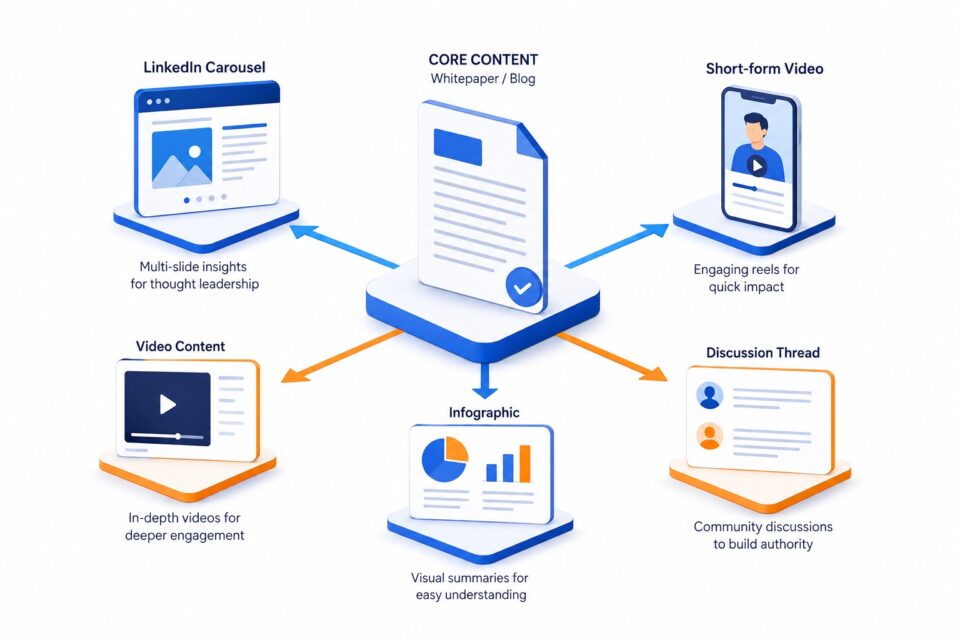
One of the most common objections to B2B social media is the cost and effort of content creation. This objection collapses when you understand the repurposing model. Social media content for B2B is not a separate content stream — it is a downstream adaptation of the B2B content you are already creating.
Your technical whitepaper becomes five LinkedIn carousels. Your industry research report becomes a series of stat-based infographics. Your case study becomes a 90-second testimonial reel. The intellectual work is already done. Social just reformats it for a different screen, a different context, and a different audience state.
| Content Type | Platforms | B2B Use Case | Conversion Goal |
| Thought Leadership Articles | LinkedIn, Medium | Positioning founders / MDs as domain experts | Trust & Inbound enquiries |
| Short-Form Video / Reels | Instagram, LinkedIn, YouTube Shorts | Product demo clips, event snippets, team culture | Brand recall & awareness |
| Carousel Posts | LinkedIn, Instagram | Step-by-step guides, case study summaries, data insights | Saves, shares & follower growth |
| Infographics | LinkedIn, Pinterest, Facebook | Research stats, process flows, comparison visuals | Shares, backlinks & citations |
| Employee Spotlights & Advocacy | Humanise the brand, build culture narrative | E-E-A-T signals & organic reach | |
| Client Testimonials & Case Studies | LinkedIn, Facebook, YouTube | Social proof in digestible formats | Mid-funnel conversion |
| Event & Award Posts | All platforms | Announce participations, wins, speaking slots | Brand prestige & recall |
| Q&A / AMA Threads | LinkedIn, Reddit, Quora | Directly answer buyer questions | LLMO citations & organic trust |
| Paid Social Ads | Meta, LinkedIn | Targeted lead gen, retargeting, webinar promotion | Leads & conversions |
| The Repurposing Equation for B2B Brands
1 Whitepaper → 5 LinkedIn Carousels + 1 YouTube Explainer + 3 Infographics + 10 Short Insight Posts 1 Case Study → 1 Client Testimonial Reel + 1 LinkedIn Article + 2 Instagram Story Slides 1 Industry Report → 6 Data-Led LinkedIn Posts + 2 Reddit/Quora Answers + 1 Meta Ad Creative Net result: One piece of high-effort content generates 3–4 months of social content with minimal additional investment. |
5. The Cost Reality: Social vs Other B2B Channels
Budget conversations are where social media often loses the argument — not because it’s expensive, but because decision-makers don’t have clear comparative context. Here is a direct cost and effectiveness comparison across channels:
| Channel | Relative Cost per Lead | Mindset at Touchpoint | Creative Flexibility |
| Google Ads (Search) | High | Active research — high intent | Low — keyword constrained |
| LinkedIn Ads | Medium to High | Professional mindset — moderate guard | Medium |
| Meta Ads (B2B targeting) | Low to Medium | Relaxed scroll — open minded | High |
| Email Marketing | Low to Medium | Work mode — competing priorities | Low — text heavy |
| Organic Social (LinkedIn) | Low (time investment only) | Varies — moderate receptivity | High |
| Reddit / Quora (Organic) | Low (time investment only) | Solution-seeking — very receptive | Medium |
The picture is clear. Meta ads, when targeted correctly with B2B interest categories, job titles, and lookalike audiences, can deliver qualified leads at a fraction of the cost of Google Search campaigns for the same objective. For smaller B2B businesses and agencies, this is a significant strategic advantage that is consistently underutilised. Organic social and discussion forums sit at the other end — low financial cost, high value when done consistently.
6. Omnipresence and the Trust Signal Effect
There is a hygiene layer to B2B social media that rarely gets talked about but is immediately felt when it’s absent.
When a potential client evaluates your business — after a referral, after finding your website, after seeing an ad — the first thing they do is look you up across platforms. They check your LinkedIn company page. They look at your Instagram. They Google your name. If your social presence is sparse, inactive, or inconsistent, it creates doubt. If it is active, coherent, and professional, it creates confidence — before a single conversation has taken place.
This omnipresence effect is not about vanity metrics. It is a credibility signal. In today’s evaluation environment, a business without a maintained social presence is the equivalent of a business without a website in 2012.
| Omnipresence Checklist for B2B Brands
✓ LinkedIn Company Page — updated, with recent posts and complete profile ✓ Meta Business Page — active and consistent with brand guidelines ✓ YouTube Channel — at least 4–6 videos published and searchable ✓ Google Business Profile — updated and reviewed regularly ✓ Quora & Reddit — at least one brand or founder presence with meaningful contributions ✓ Industry directories and forums relevant to your sector |
7. LLMO, GEO & AEO: The AI Age Advantage of Social Presence
This is the section that most B2B marketing guides published before 2023 simply did not cover — and it is now arguably one of the most important reasons to build social presence deliberately.
LLMO stands for Large Language Model Optimisation. Just as SEO is about ranking on Google, LLMO is about ensuring your brand appears when AI tools like ChatGPT, Perplexity, Gemini, Claude, or similar platforms answer questions relevant to your industry.
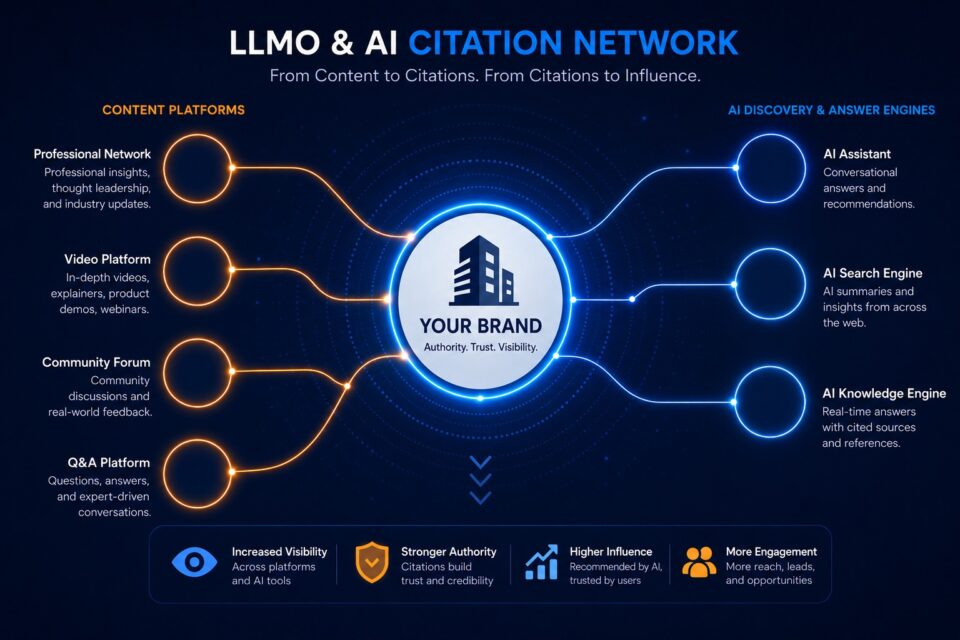
AI tools draw their knowledge from publicly available content on the internet — and the platforms they index most heavily include LinkedIn, YouTube, Reddit, Quora, and high-authority websites. A B2B brand that is actively publishing on these platforms is building what we refer to as an AI citation footprint.
| What LLMO Means for B2B Social Strategy
LinkedIn Articles and Posts — indexed by AI crawlers, especially for professional domain authority YouTube Videos — transcripts are indexed and cited by AI tools responding to how-to and explainer queries Quora & Reddit Answers — among the most frequently cited community sources in AI responses Consistent brand naming — AI tools learn to associate your brand with specific capabilities and sectors when your name appears repeatedly across trusted platforms GEO (Generative Engine Optimisation) — your content structured for AI-friendly comprehension increases citation probability AEO (Answer Engine Optimisation) — Q&A style content on social platforms and forums directly feeds AI answer databases |
The practical implication: a B2B brand that publishes a thoughtful LinkedIn article, contributes expert answers on Quora, and maintains an active YouTube channel is building a presence that compounds — both in traditional SEO and in the emerging AI discovery ecosystem.
8. Employee Advocacy: The Multiplier Most B2B Brands Ignore
Here is a channel within social media that costs almost nothing and consistently outperforms brand-only content: employee advocacy.
When your team members share company content, engage with brand posts, or publish their own professional content that references the company, three things happen simultaneously. Organic reach multiplies — LinkedIn’s algorithm rewards personal profile posts far more generously than company page content. Brand authenticity increases — a founder’s perspective or a team member’s event post carries more emotional weight than a polished corporate announcement. And E-E-A-T signals strengthen — search engines and AI tools perceive a brand with multiple visible, credible human voices as more authoritative and trustworthy.
Practically, this means building a culture where team participation in brand social activity is encouraged, recognised, and made easy. Ready-made assets, suggested captions, and internal recognition for participation are low-cost investments with compounding brand visibility returns.
9. Social as an Event & PR Amplifier
For B2B businesses that invest in industry events, trade shows, award submissions, or PR activities, social media is the amplification layer that determines whether that investment reaches beyond the room or the press release.
Event Marketing Amplification
Pre-event: Build anticipation through countdown posts, speaker announcements, and registration reminders targeted at relevant professional communities. During event: Live updates, behind-the-scenes reels, and audience interaction content that extends the event experience to your digital followers. Post-event: Key takeaways, highlight reels, award announcements, and connection follow-ups that maintain momentum long after the event ends.
The result is that a single event investment delivers content across multiple weeks of social activity — and the social evidence of your event participation becomes a credibility asset that prospects and AI tools both reference.
PR Amplification
A press feature or published article is not the end of the PR investment — it is the beginning of the social amplification cycle. Sharing PR coverage across LinkedIn and Meta, creating quote cards and short summaries from the article, and encouraging team members to amplify the coverage extends the reach of PR spend by a factor of three to five times, with minimal additional cost.
10. Creative Flexibility: The Brand Expression Advantage
Your website, your corporate decks, your industry publications — all of these are constrained by brand guidelines, messaging frameworks, and the formal expectations of the professional context in which they are used. And rightly so.
Social media, however, gives you room to breathe as a brand. It allows for educational content series that build before they sell. It allows for a founder’s personal perspective that wouldn’t fit in a whitepaper. It allows for light-touch, curiosity-triggering posts that introduce your brand to someone who wasn’t looking for you — and make them want to know more.
This creative flexibility is not about compromising brand standards. It is about expanding the emotional range of your brand’s expression, reaching potential clients in modes and moments that formal B2B content simply cannot access.

11. How Should B2B Manufacturing, Engineering, and OEM Companies Structure Social Media?
India’s B2B landscape spans a uniquely diverse set of sectors — from precision manufacturing in Pune to fintech in Bangalore, professional services in Mumbai to wellness distribution networks across Tier 2 cities. The social media strategy needs to account for both the universal principles above and the specific communication expectations of each sector.
| Sector | Social Opportunity | Recommended Content Focus |
| Manufacturing & Engineering | LinkedIn process tours, YouTube explainers, LinkedIn carousel on certifications | Behind-the-scenes factory content, precision / quality posts, export capability showcases |
| Professional Services (Legal, CA, Consulting) | Thought leadership on LinkedIn, Quora answers, Reddit AMAs | Regulatory updates, myth-busting posts, client outcome spotlights (anonymised) |
| Fintech & BFSI | LinkedIn insights, Meta retargeting for demos | Market commentary, product education, compliance simplification content |
| Wellness & Healthcare B2B | Instagram + LinkedIn dual play | Science-backed content, practitioner testimonials, outcome metrics |
| Technology & SaaS | YouTube demos, LinkedIn case studies, Reddit community participation | Feature tutorials, ROI comparison posts, integration guides |
| Logistics & Supply Chain | LinkedIn and Facebook for relationship nurturing | Delivery metrics, partnership announcements, operational updates |
12. B2B Social Media Strategy: Implementation Checklist
Use this as your operational starting point. The goal is not to do everything at once — it is to build systematically toward an integrated social presence that compounds over time.
| Action | Priority Level | |
| ☐ | Claim and optimise LinkedIn Company Page with consistent branding | High — Foundation |
| ☐ | Set up Meta Business Page with full profile and contact info | High — Foundation |
| ☐ | Create a content repurposing workflow: long-form → social adaptations | High — Cost Efficiency |
| ☐ | Publish at least 3 LinkedIn posts/week using the content mix above | High — Consistency |
| ☐ | Launch a Meta retargeting campaign for website visitors | Medium — Paid ROI |
| ☐ | Encourage employee advocacy with branded content for sharing | Medium — E-E-A-T & Reach |
| ☐ | Set up a YouTube channel and upload at least 4 videos/quarter | Medium — LLMO |
| ☐ | Create branded answer responses on Quora and Reddit | Medium — LLMO Citations |
| ☐ | Run LinkedIn Thought Leadership Ads on best-performing posts | Medium — Paid Reach |
| ☐ | Implement UTM tracking on all social links for proper attribution | High — Measurement |
| ☐ | Set monthly KPI reviews: engagement, CTR, leads, brand search volume | High — ROI Accountability |
Conclusion: Social Media is Not Optional for B2B Anymore
The brands that treated social media as a ‘nice-to-have’ in their B2B marketing mix five years ago are now playing catch-up — in search rankings, in AI discoverability, and in the mental availability stakes that determine which vendors get shortlisted when a buying decision eventually surfaces.
The argument was never that social media replaces whitepapers, research reports, or enterprise content marketing. It doesn’t. The argument is that social media is the connective tissue of a B2B integrated marketing strategy — the layer that makes everything else more visible, more trusted, and more likely to be found by the right people, in the right mindset, at the right moment.
B2B businesses that build genuine, consistent, sector-relevant social presence in 2026–27 will find that it pays dividends across every other marketing initiative they run — and that the cost of building it is far lower than the cost of the visibility they are currently leaving on the table.
| Final Thought for Business Leaders
Your next best client is almost certainly on LinkedIn, Instagram, YouTube, or Quora right now. Whether your brand shows up for them — in a useful, credible, memorable way — is entirely within your control. Social media for B2B is not about chasing trends. It is about being present where your buyers are, in the moments when they are most open to what you have to say. |
Frequently Asked Questions
These FAQs are structured for search engine featured snippets, AI-powered answer engines (ChatGPT, Perplexity, Gemini, Claude), and human readers seeking quick, direct answers.
| Question | Answer |
| Is social media really useful for B2B companies? | Absolutely. B2B purchase decisions are made by humans who are active on social platforms — not just LinkedIn but also Meta. Social media builds brand recall, trust, and LLMO citations that directly influence inbound leads over time. |
| Which social media platform should a B2B company prioritise first? | LinkedIn is the natural starting point. It offers professional targeting, thought leadership positioning, and direct reach to decision-makers. However, Meta platforms should not be ignored for brand recall and lower-cost retargeting. |
| How much does social media marketing cost for B2B? | Organic social costs primarily time and content repurposing. Meta paid ads for B2B can begin at a relatively low budget and still generate meaningful results — significantly more cost-efficient than equivalent Google Ads spend for the same B2B objective. |
| How is social media content different from B2B content like whitepapers? | Social content is the downstream, lighter adaptation of core B2B content. A whitepaper becomes a carousel. A research stat becomes an infographic. A case study becomes a testimonial reel. The thinking is already done — social just adapts it for a different format and scroll context. |
| Does social media presence actually help with Google ranking? | Directly, social media links are not counted as SEO signals by Google. Indirectly, it drives traffic, brand search volume, backlinks, and E-E-A-T signals — all of which have proven positive correlation with improved Google rankings. |
| What is LLMO and why does it matter for B2B brands? | LLMO (Large Language Model Optimisation) is about ensuring your brand is cited or referenced when AI tools like ChatGPT, Gemini, Perplexity, or Claude answer questions in your domain. Presence on LinkedIn, Quora, Reddit, and YouTube increases the likelihood of AI tools citing or mentioning your brand. |
| How should B2B companies measure social media ROI? | Key metrics include: reach and impressions (awareness), engagement rate (content resonance), link clicks and website sessions (intent signals), lead form fills via LinkedIn or Meta (direct ROI), and brand search volume growth (longer-term recall indicator). |
| Can a small B2B firm or business actually compete on social media? | Yes — especially through niche authority. A focused content strategy targeting one sector with consistency and genuine expertise outperforms a large brand posting generic content. Social algorithms favour engagement, not budgets. |
About This Article
This article is authored based on direct, hands-on experience across multiple sectors. The strategies, data benchmarks, and frameworks presented are drawn from real-world client engagements and observed commercial outcomes — not from theoretical models or secondary research aggregation.
This article does not represent or endorse any specific agency, platform, or vendor. The intent is to provide actionable, experience-backed perspective to decision-makers evaluating the commercial case for digital marketing investment.
Notes & Disclaimers
- This article is written for members of the business community in the B2B space and is not intended for academic use.
- For branding and digital marketing strategies in specialised sectors, please share your business context and objectives at: info@acelogicsolutions.com
About Ace Logic Solutions
Ace Logic Solutions is a Mumbai-based digital marketing and brand solutions agency, founded in 2019. We specialise in building integrated digital marketing strategies for B2B and D2C brands across manufacturing, engineering, professional services, fintech, wellness, and technology sectors.
With 100+ clients across 24+ sectors, our work spans brand strategy, SEO, LLMO, social media management, performance marketing, and integrated content production.
If this article prompted a question about your own B2B social media strategy, we’d be happy to talk.
www.acelogicsolutions.com | info@acelogicsolutions.com
[simple-author-box]
[…] mental model that works: social media is the hook, your website and content are the line. A compelling LinkedIn post about a successful industrial […]
[…] Social media and retargeting ads […]