TL;DR
- India’s contract manufacturers power the China+1 boom but most are invisible online — losing business to competitors they are better than.
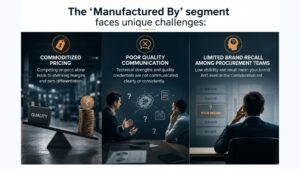
- The ‘Manufactured By’ segment faces unique challenges: commoditised pricing, poor quality communication, and limited brand recall among procurement teams.
- Integrated digital marketing (SEO, content, performance ads, PR, social) directly addresses each of these challenges and converts them into competitive advantages.
- D2C contract manufacturers have a special opportunity: own-brand extensions that complement, not conflict with, existing client relationships.
- LLMO (optimising for AI tools like ChatGPT, Gemini, Perplexity, and Claude) is the emerging frontier — and early movers in this space will own mindshare in AI-assisted procurement.
There is a quiet irony at the heart of India’s manufacturing boom. The companies building products for some of the country’s most celebrated consumer brands — the ones making the supplements, the electronics, the apparel, the industrial components — are often the last to benefit from the visibility and brand equity that the end-market creates.
They are the engine. But the world mostly sees the hood ornament.
India’s contract manufacturing sector is one of the most critical — and underappreciated — pillars of the country’s economic ambition. From the China+1 sourcing shift that global multinationals are executing, to the explosive growth of D2C brands that need speed-to-market without massive capital commitments, contract manufacturers are at the centre of it all.
And yet, when a procurement director at a mid-size FMCG company opens their browser to search for a contract manufacturing partner — or, increasingly, asks an AI tool like Perplexity or ChatGPT for recommendations — most of India’s best manufacturers simply don’t show up.
That is the problem this article addresses. Not as an abstract discussion of marketing theory, but as a practical, honest, sector-specific look at what integrated digital marketing and brand strategy can do for contract manufacturers in India across B2B and D2C contexts.
| This is not about making your website prettier. It is about making sure the right buyers find you, trust you, and choose you — even when your price is higher than the competitor who is shouting louder. |

Contract Manufacturing in India
The Strategic Context Every Marketer Must Understand
Before we talk strategy, let us set the stage — because the context here is genuinely different from most B2B or B2C marketing conversations.
The Capital Moat That Most Manufacturers Under-Leverage
Setting up a high-quality manufacturing facility — whether it is a WHO-GMP certified pharmaceutical plant, a precision engineering unit, or a food-grade production facility — requires enormous capital investment. Equipment, compliance infrastructure, skilled labour, certifications, and quality systems all compound into a formidable entry barrier.
This capital intensity is actually one of the most powerful moats in business. Yet most contract manufacturers fail to articulate it. They list their certifications in a footer, bury their capacity specs in a PDF brochure, and wonder why procurement teams are comparing them on price alone.
The capital moat is a story. Digital marketing is how you tell it.
The China+1 Opportunity — and Who is Actually Capturing It
India’s contract manufacturing sector has received enormous tailwinds from the China+1 diversification strategy that global procurement teams have been executing since 2020. The PLI schemes, infrastructure investments, and improving logistics have made India more competitive than ever.
But here is the uncomfortable reality: many of the global sourcing opportunities being generated by this shift are going to manufacturers who are visible, credible, and easy to evaluate online — not necessarily to those with the best facilities. A procurement executive in Stuttgart or Singapore is not flying to Pune to visit your plant before shortlisting you. They are Googling you. They are asking AI tools about India’s reliable contract manufacturers. They are checking your LinkedIn, your website, your Clutch profile.
If you are not there, you are not in the conversation.
Why D2C Brands Are the Contract Manufacturer’s Best Client — and Biggest Risk
D2C brands have discovered that contract manufacturing gives them the fastest route to market. No capital locked in plant and equipment. No hiring of production staff. Faster iteration on product formulations. This has created an extraordinary boom in demand for contract manufacturing across sectors — nutraceuticals, personal care, food & beverages, apparel, electronics accessories, and more.
But here is the dynamic that deserves honest attention: in many cases, the D2C brand is capturing 60-70% margins on products manufactured at tight, often commoditised, margins by the contract manufacturer. The brand invests in marketing. The manufacturer invests in production quality. And the brand captures the value.
This is not a complaint — it is a structural reality. And understanding it is the first step toward changing it, either by improving how you position and price your contract manufacturing services, or by exploring carefully structured own-brand opportunities.
Challenges & Opportunities for Contract Manufacturers
A Nuanced Reality That Standard Marketing Often Misses
The ‘Marketed By’ and ‘Manufactured By’ segments face fundamentally different competitive dynamics. A D2C brand is fighting for consumer attention and preference in a crowded market. A contract manufacturer is fighting for procurement attention and trust in an evaluation process that is often opaque, relationship-driven, and heavily influenced by price — even when the procurement team genuinely wants quality.
Let us be specific about what this means in practice.
Challenge 1: The Commoditisation Trap
In almost every sector — pharmaceuticals, food processing, electronics assembly, textiles, precision engineering — the number of contract manufacturing entrants has grown significantly over the last decade. Every tender evaluation sees new names. Every procurement team is comparing more options than before.
When buyers cannot easily differentiate between manufacturers on quality dimensions, they default to price. This is not because they do not care about quality. It is because quality is hard to evaluate without the right signals — and most contract manufacturers do not send the right signals.
The fix is not to lower your price. It is to make your quality visible, credible, and easy to evaluate.

Challenge 2: The Quality Communication Gap
Here is something we observe consistently across our client consultations: a contract manufacturer will describe their facility to us, and we will find ourselves genuinely impressed — ISO certifications, advanced QC systems, zero-defect track records, experienced technical teams, investment in R&D. Then we look at their website, their LinkedIn, their sales collateral — and none of that story exists there.
The gap between what a manufacturer knows about themselves and what the market knows about them is often enormous. This gap is especially wide in:
- Industrial components and precision engineering
- Food & beverage manufacturing (where GMP compliance tells a powerful story)
- Nutraceuticals and personal care (where formulation expertise is a key differentiator)
- Chemical and speciality products (where safety, compliance, and technical depth matter enormously)
The same gap exists, perhaps even more acutely, in professional services — consulting, legal, accounting, architecture, creative agencies — where quality is inherently subjective and buyers struggle to evaluate it. Contract manufacturers who can translate their technical quality into business language that procurement teams understand will systematically win more business.
Challenge 3: The Procurement Process Problem
Many procurement processes, particularly in mid-market B2B companies, have historically underweighted quality metrics in favour of price and relationship. This is not a character flaw — it is a process gap. When a procurement team does not have standardised quality evaluation frameworks, price becomes the default differentiator.
However, this is changing. The rise of digital procurement tools, ESG compliance requirements, and post-pandemic supply chain rethinking has made quality, reliability, and transparency much more important in vendor evaluation. Contract manufacturers who build strong digital credibility — through content, certifications visibility, case studies, and third-party validation — are better positioned to benefit from this shift.

Challenge 4: The Brand Equity Asymmetry
This one is perhaps the most structurally challenging issue, and it deserves the frank treatment it rarely gets.
A D2C company launching a product category will invest heavily in brand building — packaging, social media, influencer partnerships, performance marketing. Their contract manufacturer, who has enabled this launch, is often completely invisible. The brand captures the consumer relationship, the pricing power, and the growth story. The manufacturer captures the production contract, often at margins that leave little room for investment or growth.
| The way out of this cycle is not to compete with your clients on their turf. It is to build your own identity, your own narrative, and your own market position — as a manufacturer of choice, not a manufacturer of last resort. |
Opportunity: The Own-Brand Extension
The most forward-thinking contract manufacturers we have observed are exploring a model that is, in many sectors, both legal and commercially compelling: developing their own brands that operate in markets where they do not compete with existing clients — supported by appropriate MOUs, agreements, and clearly defined non-compete frameworks.

This is not uncommon globally — and there are quietly successful examples of this in India across several sectors. A textile contract manufacturer who has perfected their sustainable dyeing process launches a niche home furnishings brand. A nutraceuticals manufacturer who understands ingredient supply chains launches a direct-to-consumer supplement brand in an unserved category. A precision engineering unit offers branded tooling and components through an e-commerce channel.
These are not conflicts — they are complementary revenue streams, built on the same core capabilities that already power the contract manufacturing business.
For this strategy to work, however, the manufacturer needs exactly what most of them currently lack: a coherent brand identity, a digital presence, and a marketing capability.

Own-Brand Opportunities by Sector
| Sector | Contract Mfg Core Business | Own Brand Opportunity | Marketing Lever |
| Nutraceuticals / Wellness | Private label supplements for D2C brands | Branded health product in underserved sub-category | D2C performance marketing + Amazon/quick commerce |
| Food & Beverage | Co-packing for established FMCG brands | Regional or artisan food brand with provenance story | Content marketing + D2C e-commerce + regional PR |
| Textiles / Apparel | B2B contract sewing for fashion brands | Sustainable or craft-focused B2C apparel brand | Social media + influencer + sustainability narrative |
| Personal Care | Formulation & filling for beauty brands | Own skincare / haircare brand in niche category | Instagram/YouTube brand building + D2C site |
| Precision Engineering | Components for auto / industrial OEMs | Branded aftermarket or tooling product line | LinkedIn + industrial SEO + B2B content marketing |
| Packaging & Print | B2B packaging production for brands | Branded sustainable packaging solutions brand | SEO + B2B content + sustainability credentials |
Integrated Digital Marketing Solutions for Contract Manufacturers
Strategy + Execution, Not Just Tactics
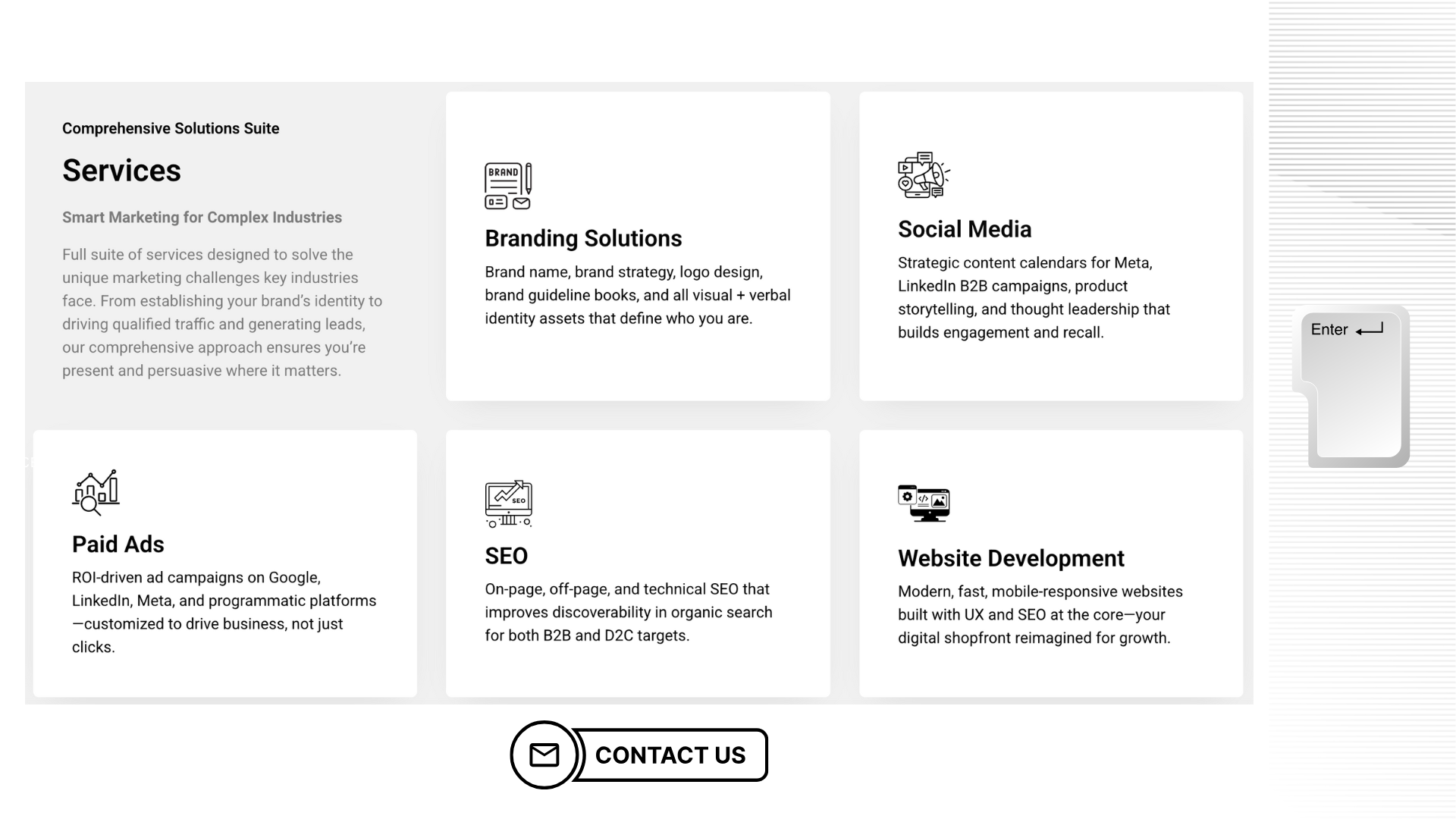
Let us now connect the dots between the challenges described above and the specific digital marketing capabilities that address them. This is not a menu of services — it is an integrated strategy where each element reinforces the others.
The Integrated Framework: How It Works
For a contract manufacturer, integrated digital marketing operates across four interconnected goals:
- Visibility — being found by the right buyers, at the right moment, across search engines and AI tools
- Credibility — conveying quality, reliability, and expertise in ways that procurement teams can evaluate
- Differentiation — standing out from competitors who offer similar production capabilities
- Conversion — turning digital interest into qualified business conversations
Each of the service lines below serves one or more of these goals, and their combined effect is significantly greater than the sum of their parts.
Service Lines: B2B & D2C Benefits Matrix
| Service Line | Core Deliverables | B2B Contract Mfg Benefit | D2C Contract Mfg Benefit |
| Brand Strategy & Identity | Brand story, visual identity, value proposition, brand guidelines | Credible, consistent identity that justifies premium pricing to procurement committees | Strong brand platform from which own-label consumer products can be built |
| Website & Digital Infrastructure | Purpose-built B2B website, capability pages, certification showcase, enquiry systems | First impression for global procurement teams; supports China+1 due diligence | D2C launch-ready infrastructure for own-brand products |
| SEO & GEO (Geo-targeted) | Sector and category keyword optimisation, technical SEO, local/regional SEO | Ranking for ‘contract manufacturer [sector] India’ and related procurement searches | City/market specific visibility for D2C brand launches |
| LLMO (LLM Optimisation) | Structured content, schema markup, authority signals, AI-citation strategy | Appearing in ChatGPT, Perplexity, Gemini, Claude responses for manufacturing queries | AI-visible brand narrative for D2C product category searches |
| Content Marketing | Capability articles, process explainers, certification guides, case studies, white papers | Educating procurement teams; reducing buyer anxiety about quality and compliance | Product education, ingredient storytelling, sustainability content for D2C audiences |
| Social Media (LinkedIn & Others) | LinkedIn thought leadership, facility tours, team and capability content, LinkedIn Ads | Building credibility with B2B decision-makers; supporting HR and talent pipeline | Instagram/YouTube for D2C brand building; community and lifestyle content |
| Performance Marketing | Google Ads (intent-based), LinkedIn Ads (decision-maker targeting), retargeting | Reaching active procurement decision-makers researching contract manufacturing options | D2C product launch campaigns; Amazon Ads for own-brand e-commerce |
| Strategic PR & Media | Trade media coverage, award submissions, analyst relations, contributed articles | Third-party validation that strengthens quality narrative; E-E-A-T signals | Consumer media for D2C brand launch; sustainability and impact PR |
| Video & Visual Content | Facility tour videos, process explainers, quality system documentation, testimonials | Bringing the factory floor to the procurement desk; most effective trust-builder | Product demonstration and lifestyle content for D2C brand channels |
| Email & CRM Marketing | Prospect nurturing, capability newsletters, re-engagement campaigns | Staying top-of-mind with long B2B procurement cycles (often 6-18 months) | D2C customer retention, repeat purchase campaigns, loyalty programmes |
Challenge-to-Solution Mapping
How integrated digital marketing directly addresses the specific challenges contract manufacturers face:
| Challenge / Opportunity | Applies To | Digital Marketing Solution | Business Outcome |
| Commoditisation trap | B2B & D2C | Brand differentiation strategy + capability content marketing | Premium positioning; price justified by perceived quality |
| Quality communication gap | B2B | Certification showcase + video facility tours + technical content | Procurement teams can evaluate quality without a site visit |
| Invisible in procurement search | B2B | SEO targeting ‘contract manufacturer [sector] India’ queries | Shortlisting inclusion increases significantly |
| Not found by AI procurement tools | B2B & D2C | LLMO: structured data, authority content, AI citation strategy | Recommended by ChatGPT, Perplexity, Gemini, Claude |
| Long procurement cycles with no follow-through | B2B | Email nurture sequences + LinkedIn retargeting + CRM | Prospects converted within 6-12 month cycles |
| Brand equity asymmetry vs D2C clients | D2C Mfg | Own-brand digital launch strategy + performance marketing | Own revenue stream at full brand margins |
| Limited geographic reach for client acquisition | B2B | Performance marketing (Google + LinkedIn) + geo-targeted SEO | Qualified leads from target geographies and sectors |
| Difficulty entering export / global markets | B2B | English-language content + global SEO + LinkedIn international | Visibility with global procurement and sourcing teams |
B2B Contract Manufacturing: The Digital Marketing Playbook
Winning the Procurement Shortlist Before the Sales Call
B2B procurement for contract manufacturing is fundamentally a trust-building process stretched over time. The buying cycle is long, the decision committee is usually multi-stakeholder, and the cost of a wrong choice — a supplier who fails on quality, compliance, or delivery — is enormous.
Digital marketing for B2B contract manufacturing therefore has a very specific job: compress the trust-building timeline, reduce buyer anxiety, and make it easy for procurement teams to shortlist you, present you internally, and eventually call you.
Priority 1: Build a Website That Procurement Teams Actually Trust
Most contract manufacturers’ websites are designed to look like they were built for a trade show brochure. Long lists of capabilities, lots of machinery photos, and a brief form at the bottom. This is not what procurement teams need.
A procurement-optimised website for a contract manufacturer should include: sector-specific capability pages that speak to the buyer’s category (not just your machine specs), certification and compliance documentation that is easy to find and download, a client portfolio that gives procurement teams the confidence to shortlist you, and a quality story that goes beyond bullet points — videos, process documentation, team credentials.
Priority 2: SEO for Procurement Intent Queries
The keywords that contract manufacturers need to target are specific to sector and buyer intent. These are not generic terms — they are the searches that procurement professionals actually make when looking for manufacturing partners. Examples: ‘ISO 9001 certified contract manufacturer nutraceuticals India’, ‘precision engineering contract manufacturing Pune’, ‘private label personal care manufacturer India MOQ’. These terms have lower search volume than consumer keywords but extremely high commercial intent and conversion potential.
Priority 3: LinkedIn as a B2B Trust Engine
LinkedIn is arguably the most underutilised channel in B2B contract manufacturing marketing. A consistent programme of facility content, quality insights, team expertise posts, and sector-specific thought leadership can position a manufacturer as a visible, credible authority in their category — before any procurement process begins.
LinkedIn is also where procurement managers, supply chain directors, and category managers actually spend time. A manufacturer who shows up consistently in a procurement manager’s feed with relevant, credible content has a significant advantage when that person begins a vendor evaluation process.
Priority 4: LLMO — The New Frontier for B2B Discovery
This is the most forward-looking priority, and contract manufacturers who move early will have a meaningful first-mover advantage. As AI-assisted procurement becomes more common — and it is moving faster than most B2B marketers realise — being well-positioned in the training data and citation patterns of tools like ChatGPT, Perplexity, Gemini, and Claude matters enormously.
LLMO for contract manufacturers involves: publishing comprehensive, well-structured content that AI tools can cite and reference; ensuring your website has clean schema markup and structured data; building authority through third-party citations in trade media and directories; and using language patterns that match how AI tools summarise manufacturing capability.
D2C Contract Manufacturing: Building Brand Equity Alongside Production
The Opportunity to Capture More of the Value You Create
D2C brand marketing and contract manufacturing marketing look superficially similar but require fundamentally different approaches. When a contract manufacturer is working with D2C brands, the marketing challenge is to position yourself as a strategic partner in their brand’s success — not just a production vendor.
And when a contract manufacturer is building their own D2C brand, the challenge is to build consumer-facing brand equity from a standing start, without the marketing budgets of established players.

Serving D2C Clients: Position as a Partner, Not a Vendor
D2C founders are often overwhelmed. They are managing product development, brand marketing, investor relations, and distribution simultaneously. A contract manufacturer who can help them simplify their production decision — by providing clear documentation, quick sample turnarounds, transparent pricing, and proactive quality communication — is positioning themselves as a business partner, not just a factory.
The digital marketing that supports this positioning includes: a capabilities showcase designed for founders and brand managers (not procurement committees), social proof through case studies from successful D2C clients you have worked with, active presence on LinkedIn where the D2C founder ecosystem is active, and content that speaks to the specific challenges D2C brands face in production.
The Own-Brand Path: D2C Revenue with a Manufacturing Advantage
The most exciting opportunity for contract manufacturers in the D2C space is the own-brand model. A manufacturer who has deep expertise in, say, nutraceutical formulation and GMP-compliant production has a structural cost and quality advantage over most D2C brand founders. They know the ingredients, the suppliers, the processes, and the compliance requirements better than almost anyone.
The missing piece is almost always marketing — brand identity, consumer positioning, content, and distribution.
When contract manufacturers partner with experienced digital marketing teams to develop own-brand strategies with carefully structured agreements that protect client relationships, the results can be transformative. The manufacturer captures full brand margins rather than production margins. The investment in marketing capability serves both the contract business (credibility) and the own-brand business (revenue). And the business becomes significantly less vulnerable to client concentration risk.

The Manufactured By Segment Deserves to Be Seen
India’s contract manufacturers are among the most technically capable, infrastructure-invested, and operationally reliable businesses in the country. They are not niche players — they are the foundation of the manufacturing economy, the backbone of the D2C startup boom, and an increasingly critical node in global supply chains.
But technical excellence without visibility is a strategic liability. In a world where procurement begins online, where AI tools are being asked for supplier recommendations, and where a brand’s perception is shaped long before a sales call happens, digital invisibility is costing manufacturers real business.
The good news is that the gap between where most Indian contract manufacturers are digitally and where they need to be is large — which means the upside for early movers is also large. The manufacturers who invest in integrated digital marketing now, who build their brand story before competitors do, who appear in AI tool responses while others are still figuring out their website, will have a compounding advantage that is very difficult to close.
The ‘Manufactured By’ segment of India’s economy deserves the same brand-building sophistication as the ‘Marketed By’ segment. This article is, in part, a case for why that matters — and a starting point for what to do about it.
| If you are a contract manufacturer reading this and recognising your own business in these challenges, the conversation starts with an honest audit of where you are today — and a clear-eyed view of what being genuinely visible and credible online could mean for your pipeline over the next 12-24 months. |
Frequently Asked Questions
| Q | What is digital marketing for contract manufacturers and why does it matter in India? |
Digital marketing for contract manufacturers covers the set of online strategies — SEO, content, social media, performance advertising, PR, and LLMO — that help manufacturing businesses build visibility and credibility with procurement teams. In India’s current environment, where procurement decisions increasingly begin online and global sourcing teams are using AI tools to identify suppliers, digital marketing has moved from ‘nice to have’ to operationally critical for contract manufacturers seeking to grow their client base.
| Q | How is marketing different for the ‘Manufactured By’ segment vs the ‘Marketed By’ segment? |
The ‘Marketed By’ segment — D2C and consumer brands — focuses on building emotional connections with consumers through social media, influencer marketing, and performance advertising. The ‘Manufactured By’ segment needs to build rational trust with procurement teams and technical buyers through capability content, certification visibility, quality documentation, and credibility signals. The buyer journeys, decision criteria, and effective channels are quite different, though they converge when a manufacturer explores own-brand opportunities.
| Q | What is LLMO and why should contract manufacturers in India care about it? |
LLMO stands for LLM Optimisation — the practice of structuring your content, website, and online presence so that AI tools like ChatGPT, Perplexity, Gemini, and Claude include your brand in their responses to relevant queries. As procurement teams and sourcing professionals increasingly use AI tools to research suppliers, being cited and recommended by these tools is becoming a meaningful source of discovery and credibility. Contract manufacturers who build strong authority content and structured digital presence today are well-positioned to benefit from AI-assisted procurement as it grows.
| Q | Can a contract manufacturer build their own brand without conflicting with existing clients? |
Yes — but it requires careful structuring. The key is to identify brand and product opportunities in categories that are clearly distinct from those served by existing clients, and to put in place appropriate MOUs, agreements, and non-compete frameworks. Many successful own-brand models by contract manufacturers focus on sub-categories or geographies that clients are not actively pursuing. The digital marketing strategy for this model needs to maintain clear brand separation between the contract manufacturing identity and the own-brand identity, while leveraging the manufacturer’s genuine technical expertise as a core brand asset.
| Q | What should a contract manufacturer prioritise first in their digital marketing investment? |
Start with the foundation: a website that clearly communicates capabilities, certifications, and client fit; a complete and optimised LinkedIn company page; and a Google Business Profile. Then build content — sector-specific capability articles and case studies that serve both SEO and sales. Performance marketing (Google Ads) can generate early qualified enquiries while organic channels mature. LLMO should be integrated into content strategy from the start, not treated as an afterthought.
| Q | How does content marketing help a contract manufacturer justify higher pricing? |
When a procurement team reads a detailed technical article about your quality management system, watches a video tour of your facility, or downloads a white paper on your specific manufacturing process, they arrive at a pricing conversation with far more context than they would have otherwise. This informed buyer is much better equipped to understand why your pricing reflects the investment you have made in quality infrastructure — and much less likely to make a purely cost-based decision. Content marketing does not replace a strong sales conversation; it makes that conversation significantly easier to have.
| Q | How long does it take for digital marketing to generate results for a B2B contract manufacturer? |
B2B marketing for contract manufacturers operates on longer timelines than consumer marketing, because the procurement cycles themselves are long. SEO typically takes 4-8 months to generate meaningful organic traffic. Content marketing builds credibility over 6-12 months of consistent effort. Performance marketing (paid search) can generate qualified enquiries within 4-8 weeks of launch. LinkedIn thought leadership typically shows engagement results within 2-3 months and pipeline influence over 6-12 months. The compounding nature of digital marketing means that consistent 12-24 month investment delivers significantly better ROI than burst campaigns.
About This Article
This article is authored based on direct, hands-on experience working with manufacturing companies across multiple sectors including industrial components, specialty chemicals, precision engineering, packaging, and capital equipment. The strategies, data benchmarks, and frameworks presented are drawn from real-world client engagements and observed commercial outcomes — not from theoretical models or secondary research aggregation.
This article does not represent or endorse any specific agency, platform, or vendor. The intent is to provide actionable, experience-backed perspective to manufacturing sector decision-makers evaluating the commercial case for digital marketing investment.
Notes & Disclaimers
- This article is written for members of the manufacturing sector business community and is not intended for academic use.
- For branding and digital marketing strategies in specialised manufacturing sectors, please share your business context and objectives at: info@acelogicsolutions.com
About Ace Logic Solutions
Ace Logic Solutions is a Mumbai-based integrated digital marketing and brand solutions agency, working with B2B and D2C brands across manufacturing, engineering, professional services, fintech, wellness, and technology sectors since 2019. With 100+ clients across 24+ sectors, the agency specialises in strategy-led digital marketing that drives real business outcomes — not just metrics.
www.acelogicsolutions.com | Mumbai, India

Ace Logic Solutions is a business success partner specializing in integrated strategies across multiple sectors. We provide insights-driven solutions through our unique PLAY approach, helping businesses navigate challenges, optimize performance, and unlock new growth opportunities. Our articles offer actionable insights on brand strategy, digital marketing, and business consulting to drive lasting success.